[vc_row type=”in_container” full_screen_row_position=”middle” column_margin=”default” scene_position=”center” text_color=”dark” text_align=”left” overlay_strength=”0.3″ shape_divider_position=”bottom” bg_image_animation=”none”][vc_column column_padding=”no-extra-padding” column_padding_position=”all” background_color_opacity=”1″ background_hover_color_opacity=”1″ column_link_target=”_self” column_shadow=”none” column_border_radius=”none” width=”1/1″ tablet_width_inherit=”default” tablet_text_alignment=”default” phone_text_alignment=”default” overlay_strength=”0.3″ column_border_width=”none” column_border_style=”solid” bg_image_animation=”none”][vc_column_text]
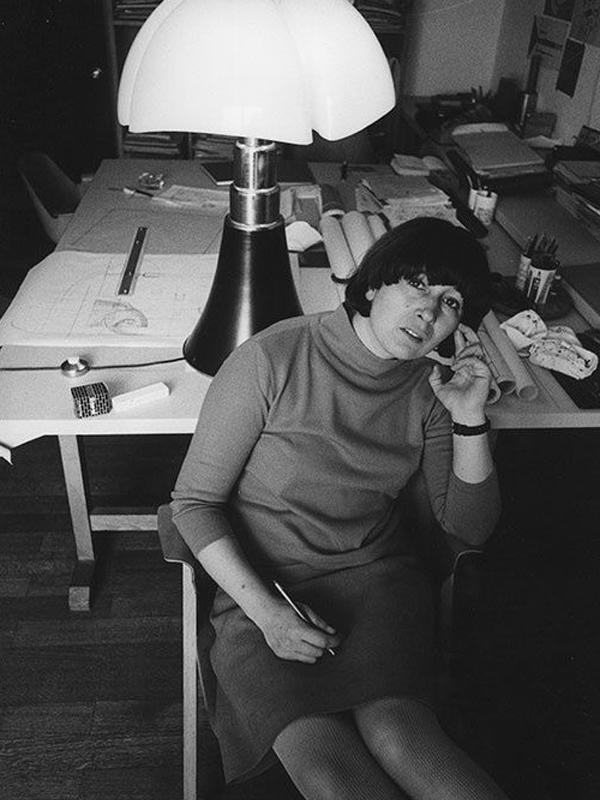
The Pipistrello lamp was created in 1965 by Italian designer Gae Aulenti, who passed away in 2012. In the early 1980s, Gae Aulenti had redesigned the Musée d’Orsay and reconfigured the interior spaces of the Centre Pompidou; this demonstrates how widely her genius was recognized.
Gae Aulenti was also one of the few women in the 1954 graduating class of the Polytechnic University of Milan, a breeding ground for great Italian designers from the 1960s to the 1980s. At that time, just after the Second World War, it was difficult for a woman, especially in a country with traditionalist values like Italy, to assert her right to excellence. Her tenacity and, above all, her genius were definitively recognized in the 1980s, which, in addition to her selection to redesign the Musée d’Orsay and reconfigure the layout of the Centre Pompidou, was expressed by the Pipistrello’s entry into the walls of the MoMA in New York, and the awarding of the Japanese Praemium Imperiale prize in 1991 for her entire body of work.
Gae Aulenti and Elio Martinelli
Pipistrello in Italian means “bat.” This explains the strange and recognizable shape of its mysterious lampshade. The Pipistrello lamp pays homage to the elegant, curved forms of Art Nouveau, which draws inspiration from the natural shapes of fauna and flora.
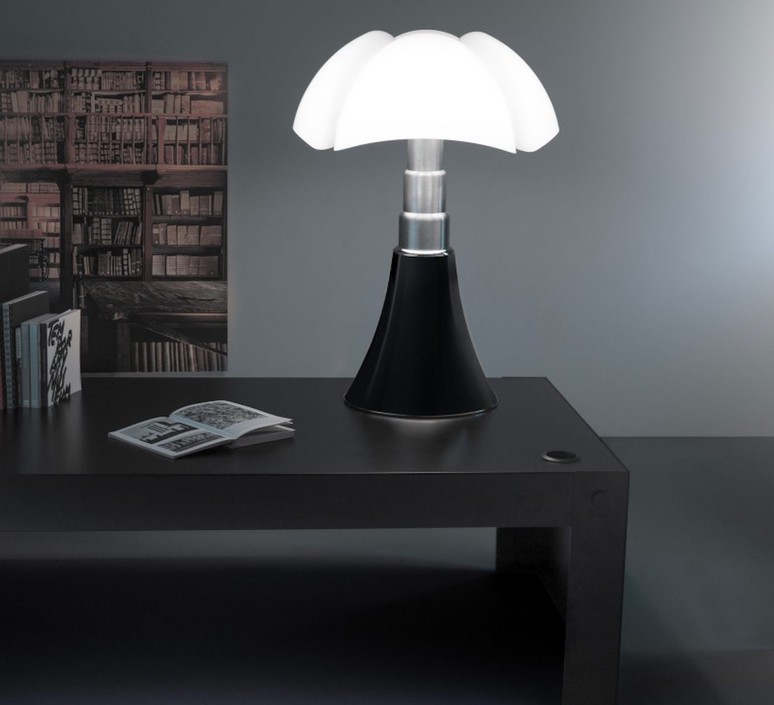
Elio Martinelli (1921-2004), who became a recognized specialist in lamp production in the 1950s with the creation of the company Martinelli Luce, also drew his creativity from nature. This is why, when Gae Aulenti approached him, sketches in hand, for the realization of her lamp, Martinelli was convinced and agreed to the project.
The Italian firm Martinelli Luce remains the sole holder of the exploitation rights for the original Pipistrello designs. Its global bestseller continues to be popular, as the Italian publisher has evolved the model over time. Thus, the Pipistrello is available in several colors such as brown, purple, and agave green (in addition to white and black). The materials have also evolved: the model is available in aluminum, copper, silver, and satin brass. In 2013, two lighter and smaller models were introduced: the Med Pipistrello (40 cm diameter, adjustable height between 50 and 62 cm) and the Mini Pipistrello (27 cm diameter, fixed height of 35 cm, weight: 2.5 kg compared to 10 kg for the original model).
Anecdotes about Gae Aulenti’s Pipistrello lamp
- On December 4, 2013, Google Italy honored it with a doodle, a secret of the search engine.
- The office of one of the characters in the series “Ainsi soient-ils,” broadcast on Arte, is equipped with a Pipistrello.
- A Pipistrello also furnishes André Dussolier’s luxurious apartment in the Franco-Belgian film “Mon pire cauchemar.”
- It also appears very often in films and television series.
The Pipistrello lamp is a cult design object that delights lovers of both retro and contemporary decor. Whatever your interior and whatever your decorating style, it will find its place.
Jbonet is an official distributor of the Pipistrello lamp. Would you like more information about this lamp? Our teams are at your disposal in our showrooms to advise you.[/vc_column_text][/vc_column][/vc_row]